
You’ve listened to your customers, identified their deepest pains, and confirmed that a solution is needed. Now comes the hardest test of a founder’s discipline: deciding what not to build.
The "Minimum Viable Product" (MVP) is a term often misunderstood. It is not a broken or "cheap" version of your product. It is the smallest version of your idea that still delivers the "core value" you promised. In today's landscape, you need to move with The Startup Sprint mentality—speed is your greatest competitive advantage.
The "Everything" Trap
Founders often feel that to compete with established players, they need a matching feature list. This is a mistake. Established players are often bloated with features nobody uses. Your advantage is focus.
If you try to build everything at once, you risk:
- Running out of cash before you even launch.
- Diluting your value proposition so users don't know what the tool is actually for.
- Over-engineering solutions for problems you haven't actually proven yet.
How to Strip Your Product to the Core
To find your MVP, look at your interview notes from the customer discovery phase. What was the one thing that made their eyes light up? That is your "Atomic Unit" of value.
- Step 1: The "Must-Have" Filter. List every feature you’ve imagined. Now, ask: "If I remove this, does the product still solve the primary problem?" If the answer is yes, delete it for now.
- Step 2: Manual vs. Automated. Does that feature need an algorithm, or can you do it yourself behind the scenes for the first 10 users?
- Step 3: The "Riskiest Assumption" Test. Use your MVP to test the part of your business you are most unsure about. Don't waste time building a "Forgot Password" flow if you haven't proven people want the core service.
Building a "Viable" Experience
While "Minimum" is important, "Viable" is equally critical. Your MVP should be:
- Functional: It actually solves the problem.
- Reliable: It doesn't crash every five minutes.
- Usable: The user doesn't need a manual to figure it out.
Even at this early stage, you should have an eye on financial management. Every feature you add has a "maintenance cost" in the future. Keeping it lean now keeps your burn rate low.
Accelerate with AI
You don't need a team of ten to build a high-quality MVP anymore. Our In-app AI-Tools can help you:
- Map out user flows so you don't miss critical steps.
- Generate code snippets or logic for your core features.
- Draft your initial database schema based on your stripped-down feature list.
If you are an incubator or university program, check out our partnership page to see how we help cohorts define their MVPs using these frameworks.
Boost your productivity. Start using our app today.
Save valuable time while learning everything you need
Your Next Step
Take your product roadmap and slash it by 50%. Focus only on the "Happy Path"—the shortest route a user takes from having a problem to finding a solution.
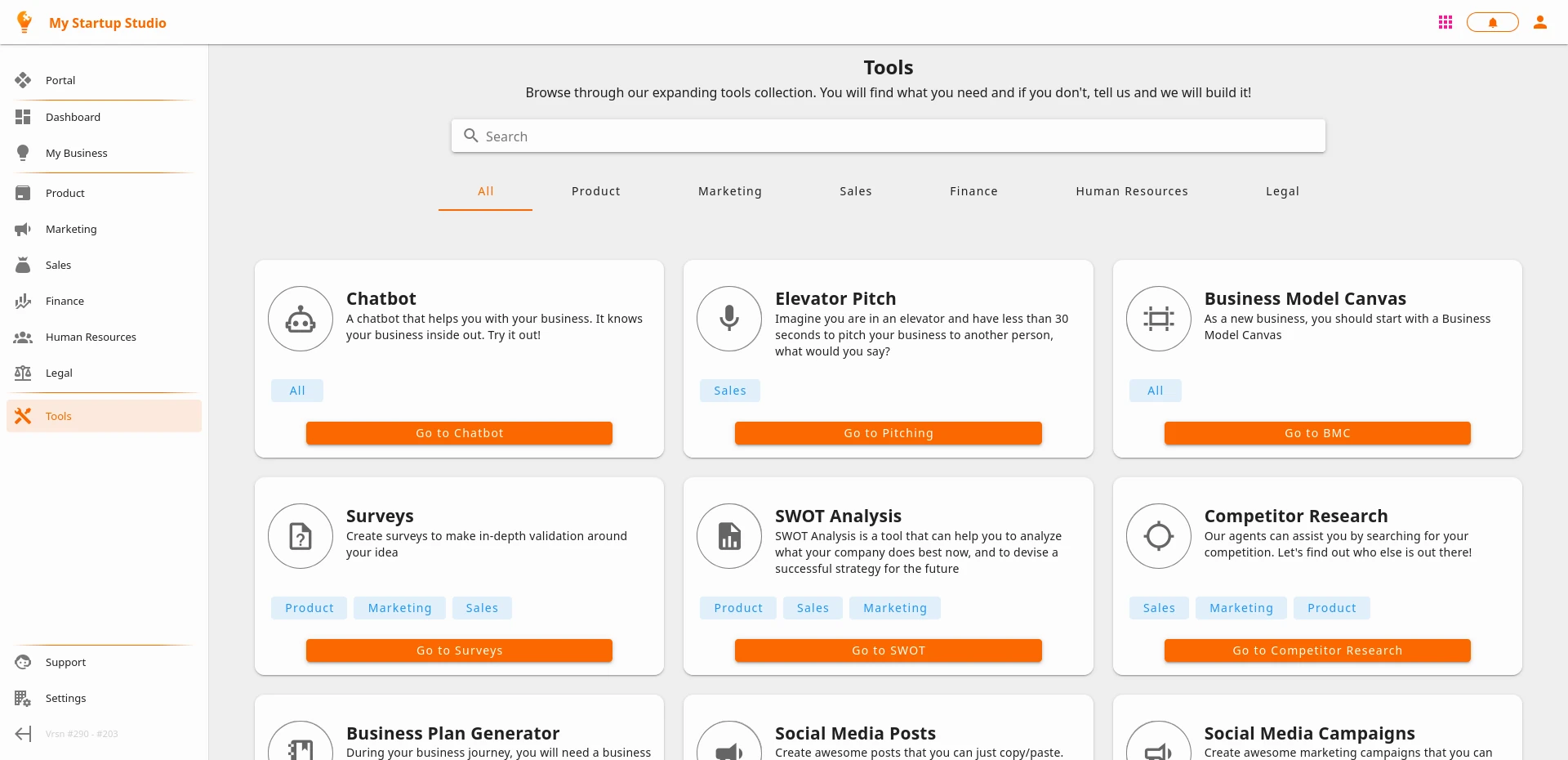
Once you have your lean feature list, go to the MyStartup.Studio App and start mapping out your MVP tasks.
Ready to build? Start your MVP journey here.
More from the Blog:
In the next article, we tackle the "Business" in Business Model: "The Unit Economics of Day One"—ensuring your lean product can actually turn into a sustainable company.